The Reuse Equation: Weighing Abrasive Recovery Against Fresh Media on UK Blast Sites
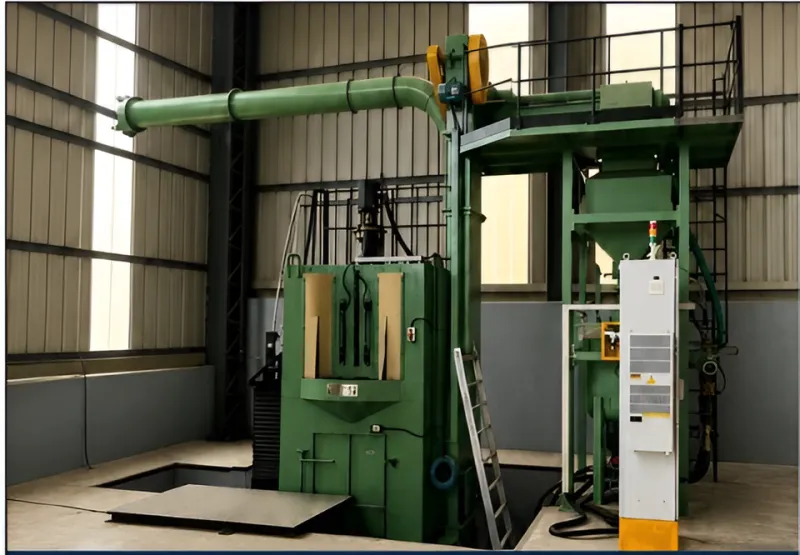
Photo: WXS2OFF, CC0, via Wikimedia Commons
On many UK blast sites, abrasive recycling is sold as a straightforward environmental and financial win: buy once, recover, reuse. The reality is more nuanced. A reclaim system changes the cost structure of a job, but it does not remove cost. It shifts spend from media purchase and disposal towards capital, power, maintenance, labour, testing and waste handling. Whether that shift leaves a contractor better off depends on throughput, substrate, coating chemistry, media type and the quality standard the client is paying for.
Start with cost per compliant square metre
The useful comparison is not cost per tonne of abrasive. It is cost per square metre blasted to the specified profile and cleanliness, with rework and stoppages included. A cheap recycled tonne that cuts slowly, generates fines or causes profile inconsistency can be more expensive than a fresh tonne that performs predictably. Contractors should build a simple model with four lines: media purchase, media disposal, plant operating cost and labour. Then divide by the area actually accepted by the inspector. That single change in perspective often exposes whether a reclaim proposal is robust or merely optimistic.
What each medium can tolerate
Garnet is brittle and breaks down in use. Recovery can work well where the system removes fines and maintains a consistent particle-size band, but repeated cycles reduce cutting efficiency. Glass bead is rounded and tends to fracture; recycling is feasible in closed cabinets and controlled environments, though the shift in shape affects surface finish. Chilled iron is dense and often magnetic, which helps separation, but it transfers more energy to the substrate and demands closer control of contamination and size distribution.
No medium is infinitely reusable. The practical question is how many cycles remain before cut rate or surface quality falls below the specification. That is a testing question, not a sales question.
The costs that do not appear on the media invoice
Reclaim equipment consumes compressed air, electricity and wear parts. Screens, classifiers, magnetic separators, cyclones and dust collectors all need maintenance. A breakdown during a tightly programmed shutdown can cost far more than the media saved. Labour is another hidden line: someone must monitor the system, change filters, remove fines and record batch history.
Contamination is the larger risk. Spent abrasive can carry coating residues, salts, oils and heavy metals. If hazardous coatings are present, recycling can concentrate contaminants and complicate both worker exposure and waste classification. Under COSHH, the contractor must assess exposure to dust and hazardous substances; under waste duty of care, the route for rejected media and fines must be documented. A reclaim system does not remove those obligations. It adds a stream that must be tested and controlled.
Testing before you trust a batch
Before reused media goes back into a blast pot, establish a batch specification. Useful checks include sieve analysis to confirm particle-size distribution, visual inspection for oversize debris, and conductivity or salt testing where corrosion-sensitive substrates are involved. Oil and moisture contamination should be assessed for coatings that are sensitive to surface chemistry. A simple cut-rate trial on a representative coupon can reveal loss of aggression before it affects production.
Record the results by batch and link them to the job. If the same recovered media is used across different coatings or substrates, cross-contamination becomes difficult to disprove. Segregation is not bureaucracy; it is the evidence that makes reuse defensible.
When a reclaim system earns its footprint
Recycling tends to make most sense where several conditions coincide: high media consumption, expensive or supply-constrained media, a stable substrate and coating mix, good containment, sufficient floor space, and in-house maintenance capability. A contractor blasting large steel structures to a consistent specification may justify the capital and operating burden. A cabinet operation using glass bead on a narrow product range may also find recovery viable, provided the system is designed for the particle sizes involved.
Payback should be calculated over a realistic utilisation figure, not a best-case week. Include the cost of test batches, rejected media, spares and the supervisory time needed to keep records. If the numbers still work at 60 to 70 per cent utilisation, the case is stronger than a model built on full-time operation.
When fresh media is the rational choice
Fresh media is often cheaper where jobs are small, irregular or widely dispersed. Mobile contractors with frequent site changes may find that transporting and commissioning reclaim plant costs more than buying new abrasive. The same applies where coatings are hazardous, where substrates change constantly, or where the client demands a tightly controlled surface chemistry.
Space is another constraint. Urban sites and occupied buildings rarely offer the footprint, power and noise headroom for a reclaim train. In those conditions, a clean fresh-media process with a documented waste route can be the lower-risk option.
A six-step decision sequence
First, define the surface quality standard and the media specification. Second, measure current consumption and disposal costs per compliant square metre. Third, obtain a representative sample of spent media and test it against the specification. Fourth, trial the reclaim system on a live job with batch records. Fifth, calculate payback using actual downtime, spares and labour. Sixth, review the waste route for fines and rejected media before the system becomes operational.
Abrasive recycling can be a sound investment. It is not a default. The correct choice is the one that delivers the specified surface at the lowest total cost, with a defensible safety and waste trail. Contractors who compare recovery and replacement on that basis will avoid both unnecessary capital spend and false economies.